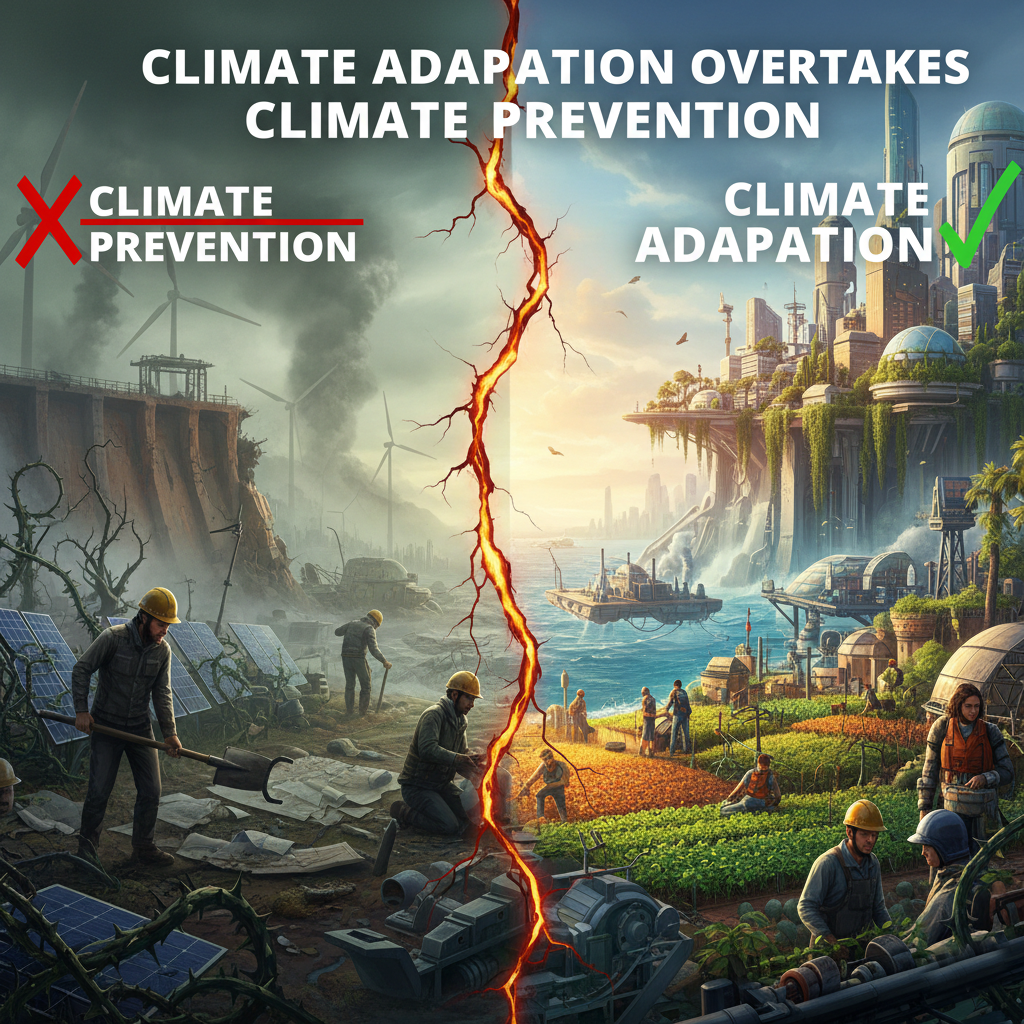
Climate Adaptation Overtakes Climate Prevention
The Quiet Shift from “Saving the Planet” to “Surviving It”
There was a time when the climate conversation sounded like a rescue mission.
“Save the planet.”
“Stop global warming.”
“Cut emissions before it’s too late.”
The language was urgent, but it carried an assumption: we still had time to prevent the worst.
In 2026, something has changed.
The banners are still there. The net-zero pledges still circulate. The sustainability reports are thicker than ever. But behind closed doors—in government offices, insurance boardrooms, infrastructure planning meetings, and military briefings—the tone is different.
Less about stopping what’s coming.
More about enduring it.
Quietly, almost without announcement, climate adaptation has overtaken climate prevention.
And that shift tells us something profound about how the world now sees the future.
From Prevention to Preparation
Prevention was about reducing emissions—mitigation strategies to slow or halt temperature rise. It focused on renewable energy transitions, electrification, carbon pricing, and phasing out fossil fuels.
Adaptation, on the other hand, begins with a harder truth: some level of climate disruption is already locked in.
You don’t adapt to a possibility.
You adapt to inevitability.
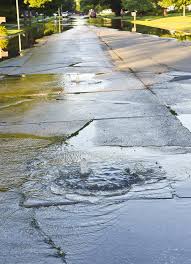
Cities are redesigning drainage systems not because flooding might happen—but because it already does. Farmers are shifting crop varieties not because rainfall patterns could change—but because they have. Coastal developers are elevating buildings not out of environmental idealism—but actuarial necessity.
Adaptation doesn’t ask, “How do we prevent this?”
It asks, “How do we live with this?”
That is a psychological turning point.
The Insurance Industry Knew First
If you want to see the future, watch insurers.
Over the past five years, major insurers have withdrawn coverage from wildfire-prone regions, coastal flood zones, and hurricane corridors. Premiums have surged. Entire neighborhoods are becoming uninsurable.
Insurance doesn’t operate on ideology. It operates on risk modeling.
And risk models are blunt: certain climate events are no longer rare. They are recurring.
When insurers recalibrate risk, governments follow. When governments follow, infrastructure changes. When infrastructure changes, budgets shift.
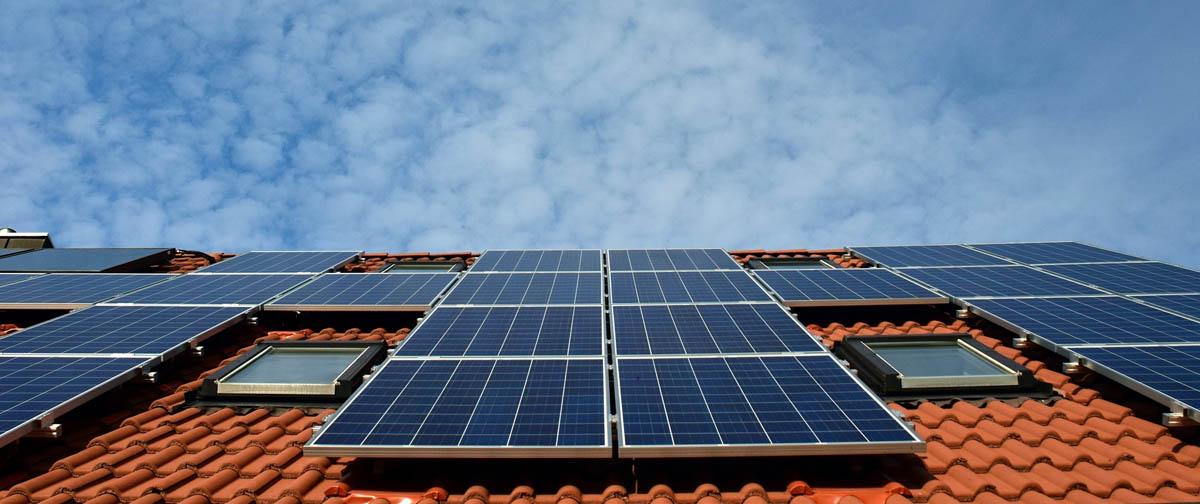
Suddenly, billions are flowing not just into solar panels—but into sea walls, cooling centers, wildfire buffers, desalination plants, and climate-resilient housing.
The financial world is pricing in survival.
The Language Is Changing
Ten years ago, climate campaigns were emotionally expansive: protect polar bears, preserve rainforests, safeguard future generations.
Today, the messaging is increasingly local and immediate:
- Protect your home from flooding.
- Prepare your community for heatwaves.
- Secure your water supply.
The scale has shrunk from planetary to personal.
This doesn’t mean people stopped caring about ecosystems. It means the threat feels closer. Tangible. Physical.
Climate change is no longer a documentary. It’s a weather alert.
And adaptation speaks the language of immediacy.
Urban Design in the Age of Heat
Cities are on the front lines.
Urban planners are rethinking entire neighborhoods around heat resilience. Reflective building materials, tree canopy expansion, shaded transit stops, permeable pavements—all once niche sustainability ideas—are becoming mainstream requirements.
In parts of Southeast Asia, including Indonesia, coastal cities are investing heavily in flood mitigation infrastructure as sea levels creep upward. Jakarta’s long-discussed capital relocation reflects not just political strategy—but environmental calculation.
These are not symbolic gestures.
They are admissions.
When a city redesigns itself for higher sea levels, it is acknowledging a future that prevention alone cannot reverse.
The Moral Tension
The rise of adaptation creates an uncomfortable ethical question:
Does preparing for impact reduce urgency to prevent it?
Critics worry that focusing too much on survival normalizes damage. That adaptation budgets could become excuses to delay emissions cuts. That resilience becomes a polite way of saying “we’ve accepted defeat.”
But the reality is more complex.
Adaptation is not surrender. It is realism.
The atmosphere does not reset because we pass legislation. Even aggressive decarbonization scenarios project warming impacts for decades to come. Heatwaves, droughts, and storms will intensify before they stabilize.
Ignoring adaptation in the name of idealism would leave communities vulnerable.
Yet overemphasizing it risks complacency.
The world now walks a tightrope between fighting the fire and fireproofing the house.
The Business of Survival
Where there is risk, there is market opportunity.
Climate adaptation is becoming one of the fastest-growing sectors globally:
- Climate-resilient agriculture technologies
- Water purification and recycling systems
- Advanced cooling solutions
- Disaster prediction AI
- Flood defense engineering
- Parametric climate insurance
Venture capital is flowing into “climate resilience tech” at record levels. Governments are issuing resilience bonds. Even real estate marketing now highlights elevation levels and flood-mitigation features.
Survival is investable.
This creates a new economy—not centered on stopping emissions, but on navigating consequences.
The Psychological Shift
Perhaps the most significant change is internal.
Prevention was hopeful. It implied agency. If we act decisively, we can stop catastrophe.
Adaptation acknowledges limits. It accepts that some damage will occur, and that resilience—not reversal—is the goal.
This is not despair. It is maturity.
Human civilization has always adapted—to ice ages, plagues, wars, and technological revolutions. Climate change, in this framing, becomes another chapter in that long story of adjustment.
But it is also the first time humanity is adapting to a planetary system it destabilized itself.
That awareness adds weight.
Inequality in the Age of Adaptation
Adaptation, unlike prevention, is uneven.
Wealthy communities can build seawalls. Install advanced cooling systems. Relocate. Retrofit infrastructure.
Vulnerable communities often cannot.
This creates a new climate divide—not just between polluters and victims, but between those who can afford resilience and those who cannot.
In 2026, climate justice conversations increasingly focus on adaptation funding. International climate negotiations are shifting from purely emissions targets to loss-and-damage compensation and resilience financing.
Because surviving climate change is expensive.
And survival should not be a luxury product.
A Quiet Realignment of Priorities
Governments still talk about net-zero by 2050. Corporations still publish carbon reduction roadmaps.
But budget allocations reveal a deeper story.
Disaster recovery funds are expanding. Military strategies include climate migration scenarios. Water security is treated as national security. Urban heat mitigation plans are embedded into public health policy.
Climate change is no longer siloed under “environment.”
It’s embedded in defense, finance, housing, and healthcare.
That integration signals permanence.
We are not preparing for a temporary crisis.
We are adjusting to a new normal.
What This Means for the Future
The shift from prevention to adaptation does not mean the planet cannot be stabilized. Emissions reductions remain essential to prevent catastrophic tipping points.
But the narrative of “saving the planet” has evolved.
The planet, in geological terms, will survive.
The question now is whether our systems—economic, agricultural, urban, social—can survive with it.
Adaptation reframes climate change as a design challenge rather than solely a moral battle.
How do we build cities that cool themselves?
How do we grow food in unstable climates?
How do we manage migration humanely?
How do we insure the uninsurable?
These are not slogans. They are engineering problems, governance dilemmas, and ethical tests.
The End of Illusion
There is something sobering about this transition.
Prevention was about preserving the world we knew.
Adaptation accepts that the world is changing—and asks who we will be inside it.
The shift is quiet because it’s pragmatic. It doesn’t fit neatly into activist chants or corporate taglines. It doesn’t inspire the same emotional crescendo as “save the Earth.”
But it may be the more honest narrative.
In 2026, climate change is no longer a future threat to avoid.
It is a present condition to manage.
And perhaps this is what growing up as a species looks like: realizing that ideal outcomes are rare, but intelligent response is still possible.
We may not fully stop the storm.
But we can decide how we stand in it.
Climate adaptation has overtaken prevention not because hope disappeared—
but because reality arrived.
The fight continues.
Only now, it includes learning how to survive what we couldn’t entirely prevent.